

Products

Resources
 Equilar Institute
 Media
MediaCompany
December 10, 2015
Featuring commentary from Hogan Lovells
In the age of Say on Pay and increasing shareholder engagement, proxy statements are communication vehicles between issuers, investors, proxy advisors and indeed all stakeholders. And while a majority of investors report that proxies represent a vital source of information for making voting and investment decisions, they also profess that these documents are excessively long and difficult to read.
Corporate issuers and boards of directors will soon be required to disclose additional information and policies in the wake of rules proposed by the Securities and Exchange Commission (SEC) earlier in 2015. Five years after Congress passed Dodd-Frank, issuers will soon need to disclose elements of executive pay and company performance versus a peer group, a clawback policy for recovering incentive-based pay following a financial restatement, and the ratio of their CEOs’ pay to that of their median employee.
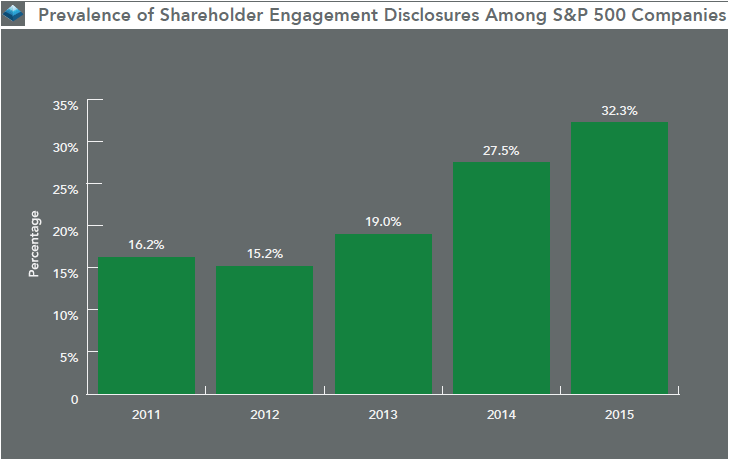
As issuers continue to engage investors and proxy advisors in a topically diverse and more frequent fashion, governance professionals and boards of directors will engage in further shareholder outreach efforts. In fact, the percentage of S&P 500 companies that disclosed direct engagement with shareholders about doubled from 16.2% to 32.3% over the last five years. Transparency among all stakeholders has become integral to these interactions, with institutional investors and proxy advisors publishing detailed voting guidelines and clear open-door engagement policies.
“Directors and executives will continue to grapple with various governance challenges in 2016, such as appropriate oversight of risks associated with business operations including cybersecurity as well as ever-present risks associated with operating in a global economy, including bribery and geopolitical volatility,” said Alex Bahn, Partner at Hogan Lovells, who contributed independent commentary to the report. “Boards will also be faced with continuing governance pressures from shareholders on transparency and access to the board, including through proxy access. Directors and executives can mitigate these challenges through robust oversight of key risk management functions as well as ongoing dialogue and interaction with shareholders to ensure key stakeholders are comfortable in the board’s understanding and responsiveness to shareholder concerns.”
This report examines trending, marquee topics in corporate governance and shareholder engagement that will affect issuer disclosures in 2016 and beyond. The extent to which S&P 500 companies disclose these elements—such as pay for performance, realized pay, modifications following shareholder outreach, adoption of proxy access, and board independence and succession planning—is displayed in terms of both overall prevalence and use of specific disclosures. The topics highlighted are a primer for both the preparation and transparency increasingly expected from stakeholders in the public marketplace.
For more information on Equilar’s research and reports, please contact Amit Batish, Director of Content & Marketing Communications at abatish@equilar.com.

Subscribe to our Newsletter to stay informed about upcoming events and webinars.


 Roles
Roles Solutions