

Products

Resources
 Equilar Institute
 Media
MediaCompany
The pace of progress toward gender diversity on corporate boards has stalled. According to the Q4 2025 Equilar Gender Diversity Index (GDI), women hold 30% of Russell 3000 board seats. This marks no change from the previous quarter, as the GDI needle remains at 0.60, where 1.0 represents gender parity between men and women.
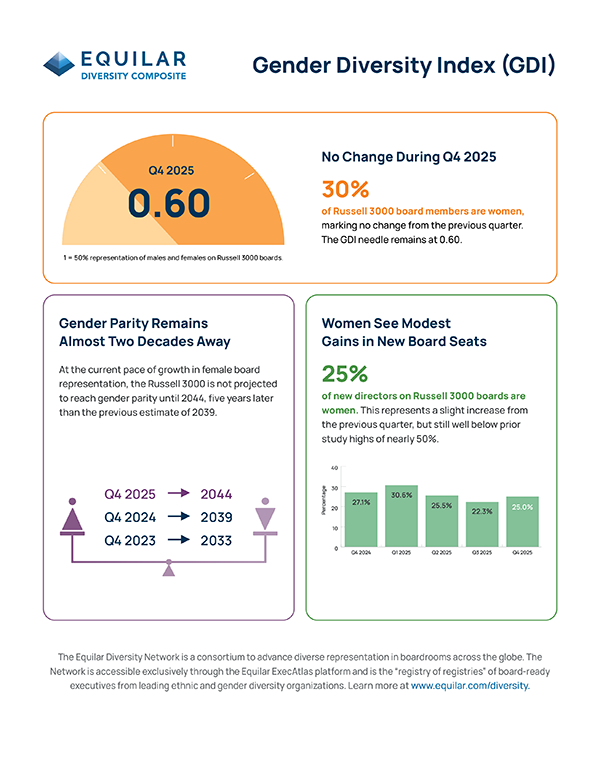
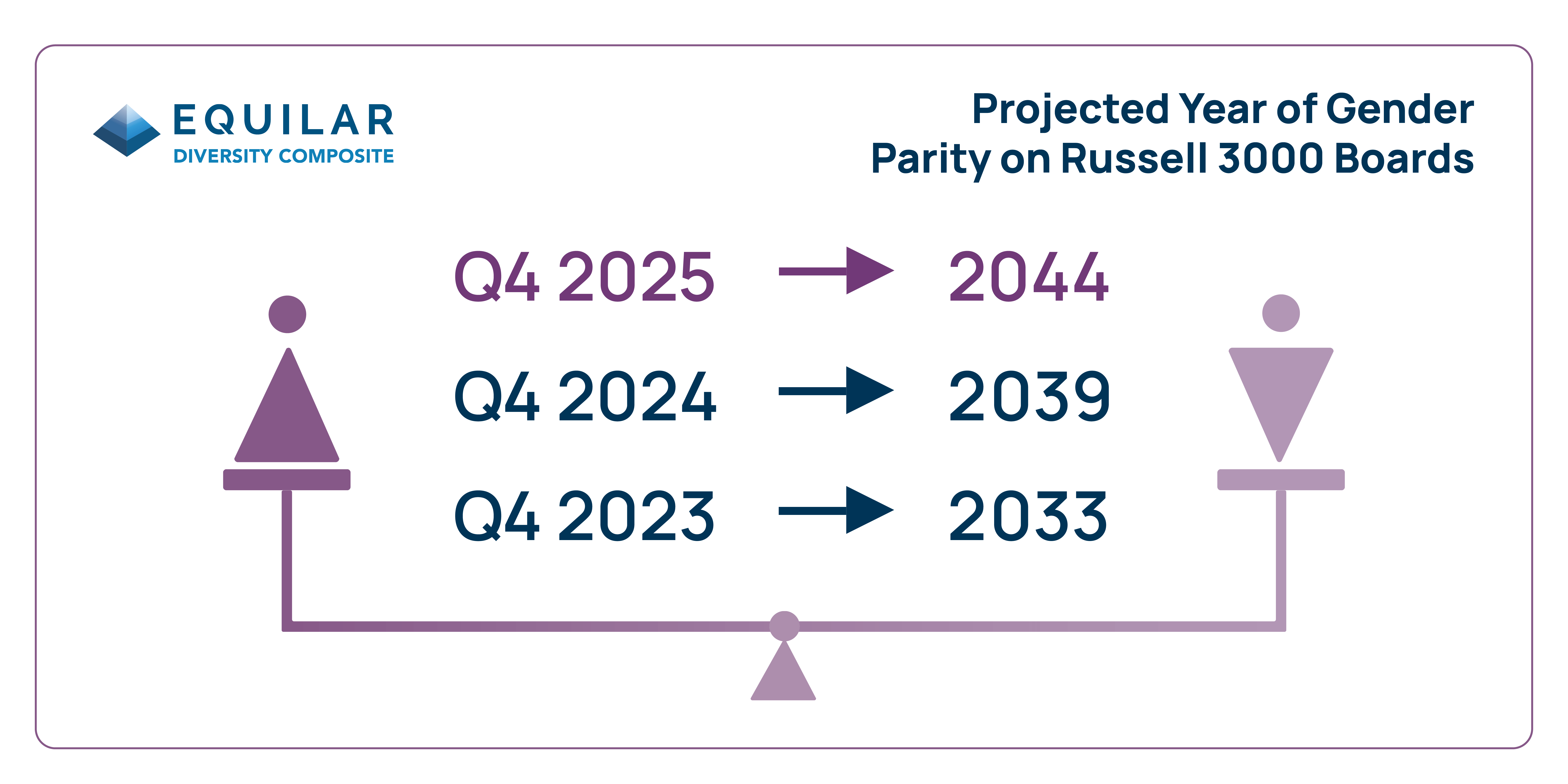
At the current rate of change, Russell 3000 boards are not projected to reach gender parity until 2044, five years later than last year’s projection of 2039. When Equilar first launched the GDI in 2017, the projected year that Russell 3000 boards would reach parity was 2055. Driven by sustained investor pressure and coordinated efforts from advocacy groups to increase board diversity, the projected timeline accelerated considerably in the years that followed. Between 2019 and 2022, the anticipated year to parity consistently hovered around 2030.
More recently, however, progress has stalled and begun to reverse. A combination of factors, including broader political backlash against DEI initiatives and the Fifth Circuit Court of Appeals’ decision to overturn Nasdaq Rule 5606, has contributed to the projected parity date being pushed further into the future. It is also possible that companies are prioritizing other dimensions of board diversity, such as racial and ethnic representation or specific skill sets, particularly amid heightened demand for AI and technology expertise.
A primary driver of the extended timeline to parity is the sharp decline in the share of new board seats filled by women over the past two years. In Q3 2025, just 22.3% of newly filled board seats went to women, the lowest level recorded since the GDI’s inception in 2017. While that figure ticked up slightly to 25% in Q4, it remains well below the peak of nearly 50% seen just a few years ago.
Meanwhile, during the fourth quarter of 2025, 173 Russell 3000 boards reached at least 50% female representation, down from 175 in the previous quarter and well below the study high of 192 boards in Q3 2024. At the same time, 2.8% of boards now have no female directors, up from 2.6% in the prior quarter.
While many players in the governance community have eased diversity-related pressures in light of the current environment, proxy advisory firm Glass Lewis announced last spring that it would maintain its existing board diversity policies. The firm also committed to flagging in its Proxy Papers when vote recommendations reflect diversity considerations, offering greater transparency for investors who prefer not to weigh such factors. Glass Lewis’ 2026 guidelines will continue to follow this approach.
“When we think about board composition, we do so through the lens of strengthening oversight and governance,” said Erin Dwyer, CEO at Women Corporate Directors. “Diverse perspectives and experiences create better strategy, improved risk oversight and more resilient organizations."
Overall, the latest data suggest that while meaningful gains have been made over the past decade, progress toward gender-balanced boards is neither linear nor guaranteed. The recent slowdown in appointing women to open seats, combined with shifting regulatory and political dynamics, has tempered earlier optimism. Absent a renewed and sustained commitment to inclusive board refreshment and succession planning, the path to parity may continue to lengthen rather than accelerate.
About Equilar Gender Diversity Index
The Equilar GDI reflects changes on Russell 3000 boards quarterly as cited in 8-K filings to the SEC. Most indices that track information about board diversity do so annually or even less frequently, and typically with a smaller sample size, sometimes looking back more than a full year by the time the information is published. The Equilar GDI aims to capture fluctuations in diversity in real time.
The Equilar GDI is powered by Equilar ExecAtlas, a database of 4M+ board members and executives. ExecAtlas includes exclusive features that show how board members and companies are connected to each other, as well as the Equilar Diversity Network (EDN), a “registry of registries” of board-ready executives from leading ethnic and gender diversity partnerships, organizations, and publications.

Senior Director of Content & Communications at Equilar
Amit Batish, Senior Director of Content & Communications at Equilar, authored this post. Equilar Researchers Ellie Do, Ignasi Garros, Grace Huang, Jacob Mendoza, Stephen Okoth, and Yuiko Shimizu contributed data and analysis. Please contact Amit Batish at abatish@equilar.com for information on Equilar data and analysis.


 Roles
Roles Solutions