

Products

Resources
 Equilar Institute
 Media
MediaCompany
The pace of women joining Russell 3000 boards appears to be slowing, according to the latest Equilar Gender Diversity Index (GDI). The Q1 2026 GDI shows that women now hold 29.9% of all Russell 3000 board seats, down from 30.3% in Q1 2025 and marking the lowest level since Q1 2024 (29.7%). The decline was not enough to move the GDI, which remained at 0.60, where 1.0 represents gender parity.
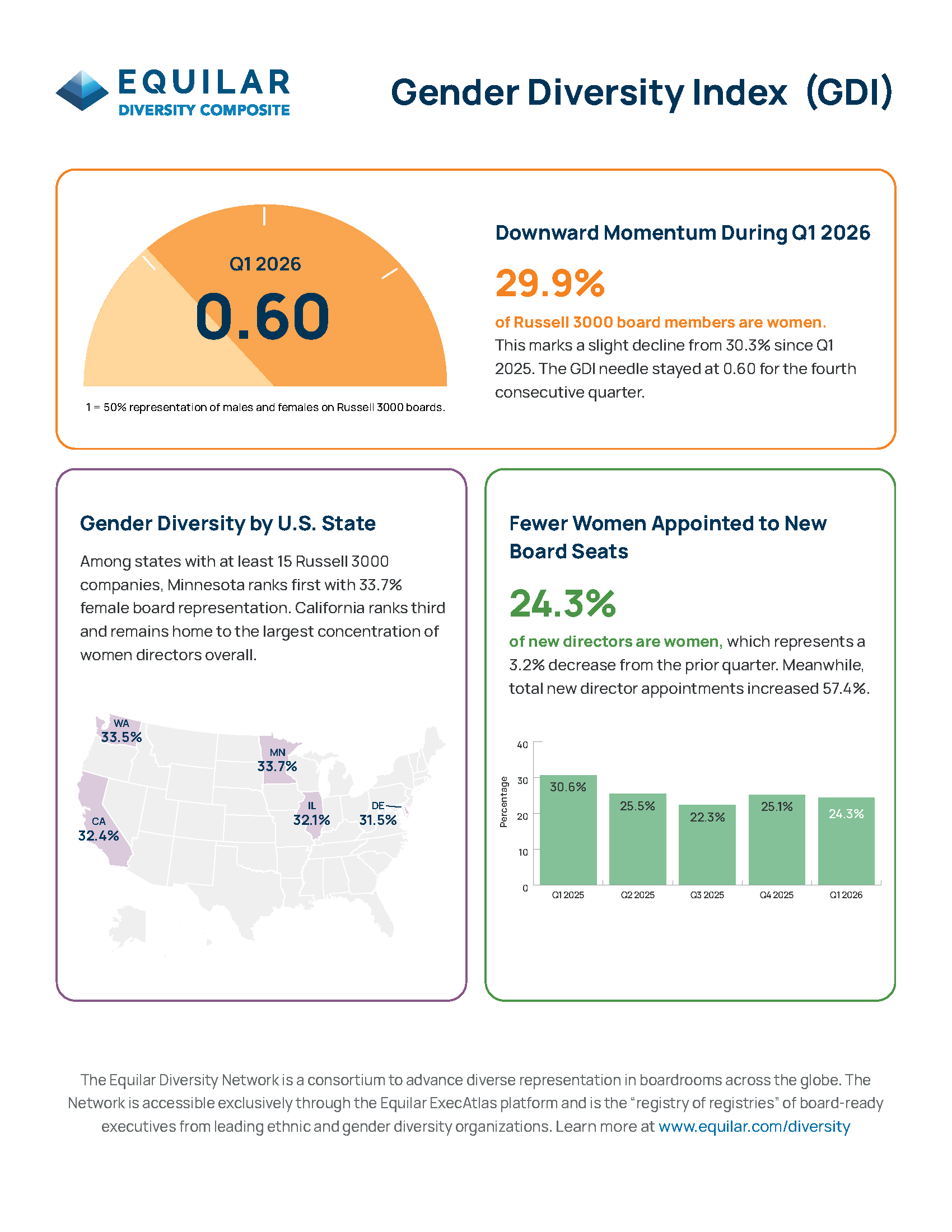
The percentage of new female directors also fell in Q1 2026, decreasing from 25.1% to 24.3% quarter over quarter, as women make up a smaller share of the current pipeline of incoming directors. At the same time, overall board refreshment accelerated. Total new director appointments increased 57.4%, rising from 411 to 647 during the first quarter of 2026. Although new female director appointments also rose by 52.4% (from 103 to 157), overall appointments grew at a faster rate, resulting in women accounting for a smaller percentage of new directors and contributing to the decline in female representation across Russell 3000 boards. This broader slowdown in female appointments is also impacting board-level parity, as the percentage of boards with at least 50% female representation edged down to 6.2% from 6.4% a year earlier.
This slowdown was also reflected among first-time board appointments. After reaching 51.5% in Q4 2025, the percentage of female directors serving on their first board fell to 40.8% in Q1 2026, marking a 20.8% decrease. This shift may indicate that companies are relying less on expanding the pool of new female candidates and instead continuing to draw from more traditional director networks.
These declining trends come amid a broader corporate pullback from diversity, equity and inclusion (DEI) initiatives and board recruitment policies. Goldman Sachs, for example, recently announced plans to drop a DEI criterion that considered candidate demographics, including gender, race, ethnicity and sexual orientation, when recruiting new directors. As companies increasingly scale back their formal diversity commitments, recent appointment patterns suggest that progress in boardroom gender diversity is also losing momentum.
Examining Diversity by State
New Mexico ranked highest among all 50 states for female board representation at 45%. The ranking, however, is based on just two Russell 3000 companies. Oregon, which held the top ranking in both Q1 2024 and Q1 2025, fell to second place in Q1 2026 with 39.1% representation.
California also saw a notable decline in ranking, dropping from eighth place in Q1 2025 to 12th place in Q1 2026, with women now holding 32.4% of board seats. Still, with 450 Russell 3000 companies headquartered in the state, California continues to represent the largest concentration of women directors overall. Among companies with at least 16 Russell 3000 companies, California ranks third, while Minnesota ranks first at 33.7% female representation.
The complete rankings for all 50 states are provided in the table below.

Associate Editor at Equilar
Joyce Chen, Associate Editor at Equilar, authored this post. Equilar Researchers Ignasi Garros, Grace Huang, Starlee Hoc, Yu-Chia Lin, Jacob Mendoza, Stephen Okoth, Logan Ring, Yuiko Shimizu, Amory Tong and Aimee Zhang contributed data and analysis. Please contact Amit Batish, Senior Director of Content & Communications, at abatish@equilar.com for questions about the data featured in this post.


 Roles
Roles Solutions