

Products

Resources
 Equilar Institute
 Media
MediaCompany
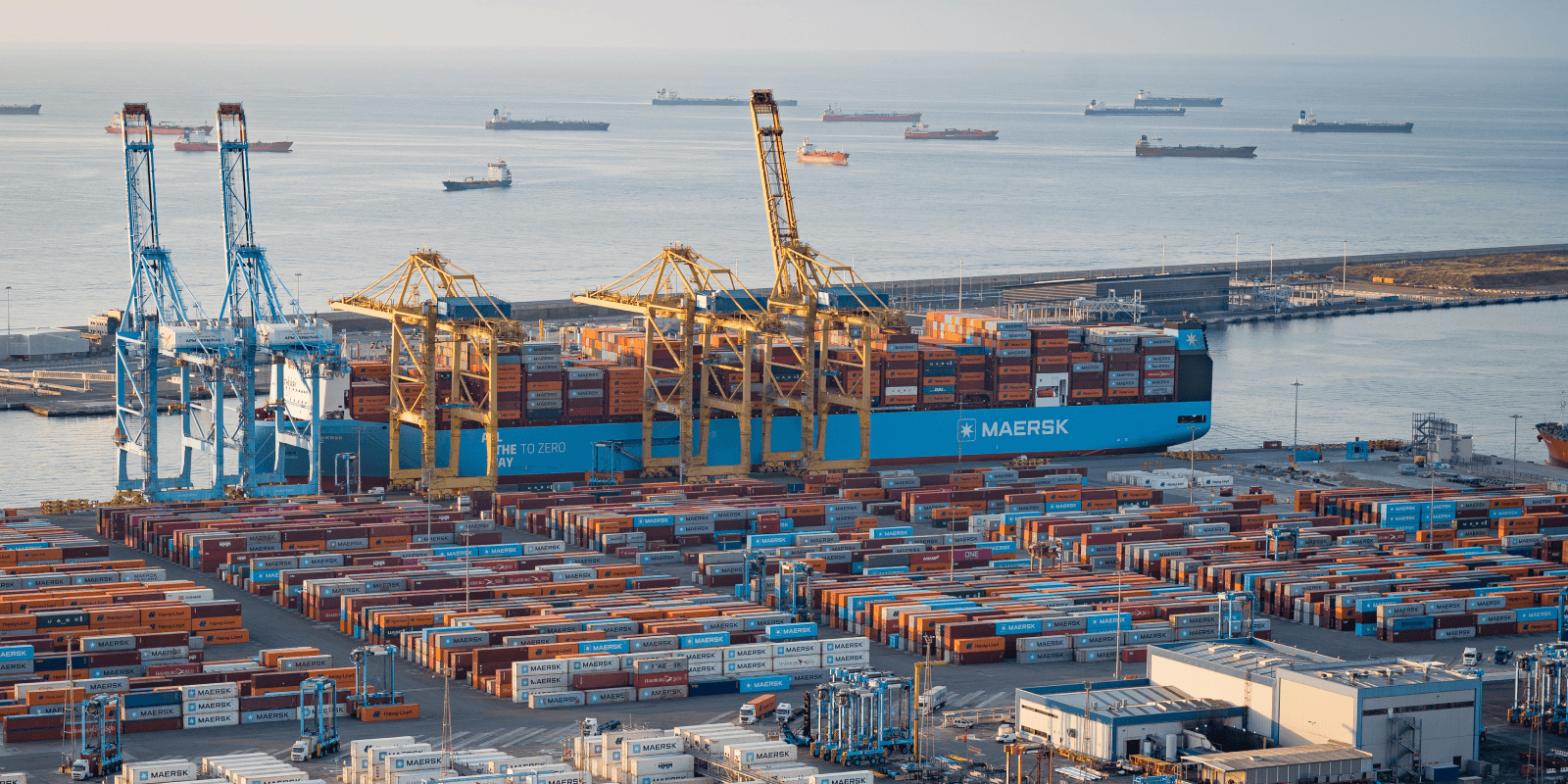
Tariffs imposed by the Trump administration in 2025 introduced a new layer of uncertainty for U.S. companies already navigating a fragile macroeconomic environment. The measures apply to imports from most global trading partners across a wide range of tariff rates, shifting constantly in response to negotiations, policy changes and foreign retaliation. During the 2026 proxy season, this uncertainty influenced how companies evaluated executive compensation programs, with many organizations addressing tariff-related impacts in their proxy statements, particularly when determining performance goals and pay outcomes.
This Equilar analysis examines U.S. public companies that disclosed tariff-related impacts during the 2026 proxy season.
Caleres, Inc. (CAL)
Caleres indicated that ongoing geopolitical uncertainty and changes in U.S. trade policy, including tariffs, limited its ability to reliably project long-term financial performance. In response, the compensation committee opted to set financial targets on a year-by-year basis for the 2025–2027 long-term incentive plan, rather than establishing multi-year goals upfront. The plan also includes a separate component tied to strategic initiatives, which will be evaluated over the full performance period.

Axon Enterprise, Inc. (AXON)
Axon adjusted its performance evaluation for 2025 cash incentives by excluding the effects of newly introduced tariffs from the adjusted EBITDA margin. The Company indicated that this modification was intended to ensure that incentive outcomes reflected underlying business performance, consistent with how the original metrics were designed.

The Children’s Place, Inc. (PLCE)
The Children’s Place highlighted how tariffs are shaping compensation decisions in the 2026 proxy season. The human capital & compensation committee (HC&C) did not set performance metrics in the first half of fiscal 2025 due to unpredictable macroeconomic conditions and leadership transitions. Performance metrics were established in the second half of 2025, though targets were not met. The HC&C noted that performance was impacted by external factors outside management’s control, including tariffs and other economic pressures.
As a result, the committee placed greater emphasis on how management responded to these challenges, rather than strictly on financial performance. Ultimately, the committee awarded bonuses to the NEOs (other than the CEO) based on those discretionary assessments of management’s performance.

MGP Ingredients, Inc. (MGPI)
In MGP Ingredients’ 2026 proxy statement, the compensation committee exercised discretion under its STI plan to modify performance results for 2025 related to tariff impacts. Specifically, the committee approved adjustments to key financial metrics, including adjusted operating income, adjusted EBITDA and adjusted basic EPS, to account for tariff impacts that were not reasonably predictable when targets were originally set.

Ross Stores, Inc. (ROST)
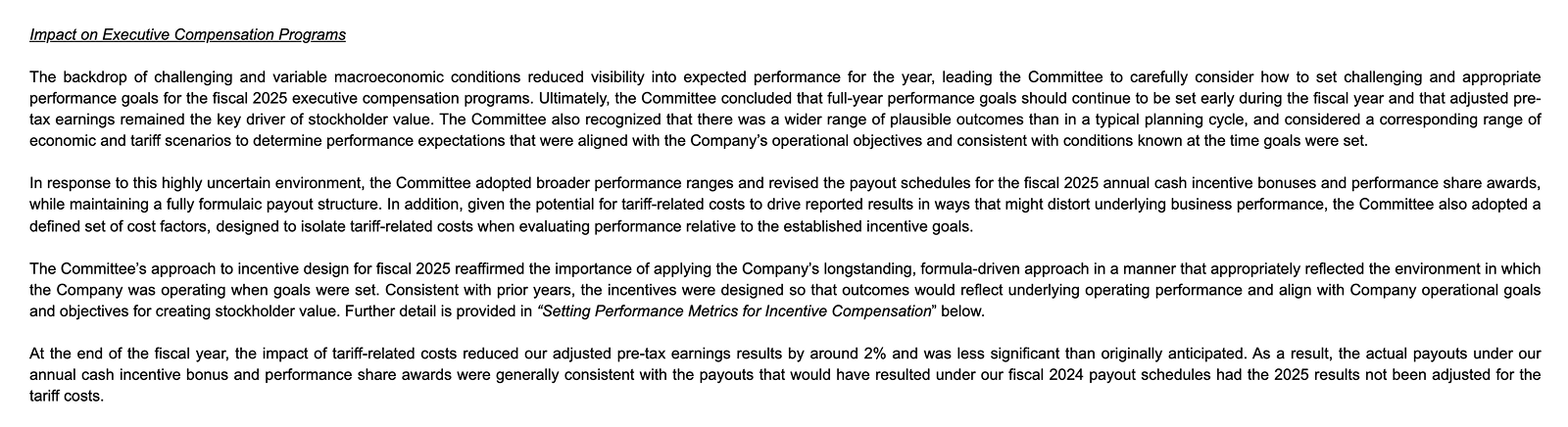
In response to the heightened uncertainty from volatile macroeconomic and tariff conditions, Ross Stores’ compensation committee broadened performance ranges and revised payout schedules, while maintaining its longstanding formula-driven structure. To prevent tariff-related costs from distorting results, the committee also introduced specific cost factors to isolate these impacts in performance evaluations.
Tariff costs ultimately reduced adjusted pre-tax earnings by approximately 2%, which was less than initially anticipated. As a result, incentive payouts for annual cash bonuses and performance share awards were largely in line with what would have been delivered under the prior year’s payout structure without tariff-related adjustments.
Integer Holdings Corporation (ITGR)
Integer Holdings’ compensation committee initially set 2025 STI-adjusted operating income targets and later adjusted them downward by $15 million to account for potential tariff impacts, while incorporating a framework to adjust payouts based on actual results. At year-end, the committee determined that tariffs did not materially affect the Company and applied negative discretion to reduce payouts to the level that would have been achieved without the tariff-related adjustment.


Associate Editor at Equilar
Joyce Chen, Associate Editor at Equilar, authored this post. Andrew Gordon, Senior Director of Research Services, provided data and analysis. Please contact Amit Batish, Senior Director of Content & Communications, at abatish@equilar.com for more information on Equilar research and data analysis.


 Roles
Roles Solutions